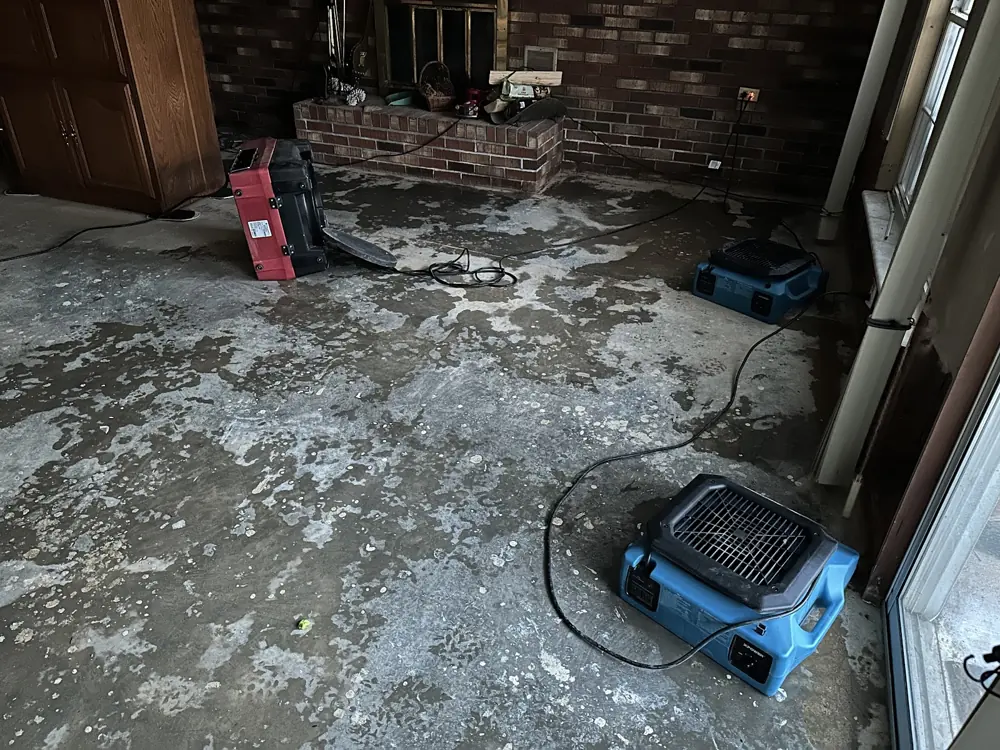
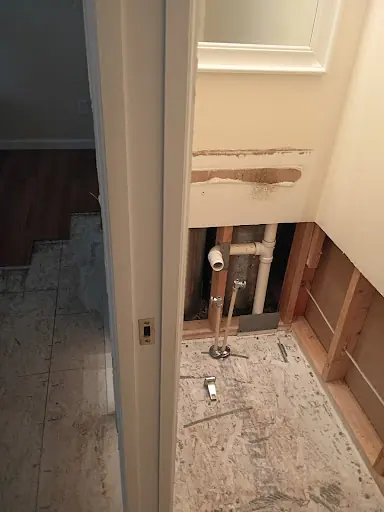
Garages sit at the low point of many San Diego homes, so storm runoff and appliance leaks pool there first. Crews respond around the clock to extract the water and dry the slab, drywall, and stored belongings before damage sets in.

A crew typically arrives within about an hour to check for electrical hazards near standing water and confirm whether the source is a leak inside or runoff from outside.
Submersible pumps and extraction units clear standing water from the garage slab, and stored items in the water are moved out and sorted.
Saturated drywall, baseboards, and any finished flooring are assessed and removed where needed, especially along walls that held water the longest.
Air movers and dehumidifiers dry the slab, framing, and any finished materials to a verified moisture target, with readings logged for the claim.

While help is on the way, these first steps, done only where it is safe, limit the damage and protect the insurance claim.
Shut the supply off at the source, or close the home's main valve if the source is not obvious. Stopping the flow limits the damage more than anything else.
Switch off electricity to the affected area, but only if the breaker can be reached without standing in or touching the water.
Get a crew dispatched right away. The sooner extraction and drying begin, the more flooring, drywall, and belongings can be saved.
Take photos and a short video of the water and the affected rooms before anything is moved, so the insurance claim starts strong.
Garage water damage cleanup in San Diego typically runs from about $900 to $4,000 depending on whether the garage is finished, how much drywall and flooring must be removed, and if the water was clean or carried storm debris. A quick pump-out of clean water on a bare slab sits on the low end, while a finished garage with saturated drywall and contaminated runoff sits toward the high end. The crew documents moisture readings and photos so the homeowner can submit an accurate claim.
Crews reach San Diego and San Diego County fast, from Downtown, North Park, Hillcrest, and Point Loma to Coronado, La Jolla, Pacific Beach, National City, La Mesa, and Spring Valley. See the full list on the areas served across San Diego page.
See all areas servedEvery loss is photographed, measured, and logged from the first visit, so the paperwork holds up with the insurance carrier.
Technicians follow recognized IICRC drying standards and prove it with daily moisture readings on San Diego homes, not guesswork.
Emergency dispatch any hour of the day or night, with a real crew on the way across San Diego County, not a callback in the morning.
A real crew dispatched any hour, not a callback in the morning.
Trained technicians following recognized IICRC drying standards.
Truck-mounted, portable, and submersible for any size loss.
The loss is documented and billed to the carrier directly.
Garages usually sit at or below the driveway grade and often house the water heater and laundry hookups, so they are both the low point for storm runoff and the first place an appliance or supply leak collects. That combination makes the garage the most common spot for water to pool in a San Diego home.
Yes. A finished garage has drywall, flooring, and framing that hold water the same way any room does, so it is extracted, assessed, and dried to a verified target. Saturated drywall along the wet line is often flood-cut when readings show it cannot dry in place.
It depends on the material and the water. Items on the slab are moved out and sorted first, and non-porous belongings usually clean up, while soaked cardboard, paper, and upholstered items may not be salvageable, especially if the water carried storm contamination. Losses are documented for the claim.
Improving the driveway and yard grading, clearing drains, and sealing the garage door threshold all help, though on steep lots some runoff is hard to fully stop in a major storm. The crew can point out where water entered so the homeowner can address the drainage afterward.
A sudden interior failure like a burst water heater is often covered, while ground-level storm flooding from outside is frequently excluded and may need separate flood coverage. Documenting the source and the extent with photos and readings helps the homeowner pursue whatever applies.
San Diego crews are on call 24 hours a day, local and fast, and can be on the way within the hour.
Call (858) 533-0936